Welcome to Unpacking Meaning. If you received this from a friend and enjoy it, subscribe here.
If you cannot describe an email in one sentence, the person reading it will not know what to do with it either.
That is the one-sentence test, and it is the cleanest diagnostic I know for email sequence architecture. You just need to ask: can I articulate what this is for? If the answer is no, the email is not ready to send.
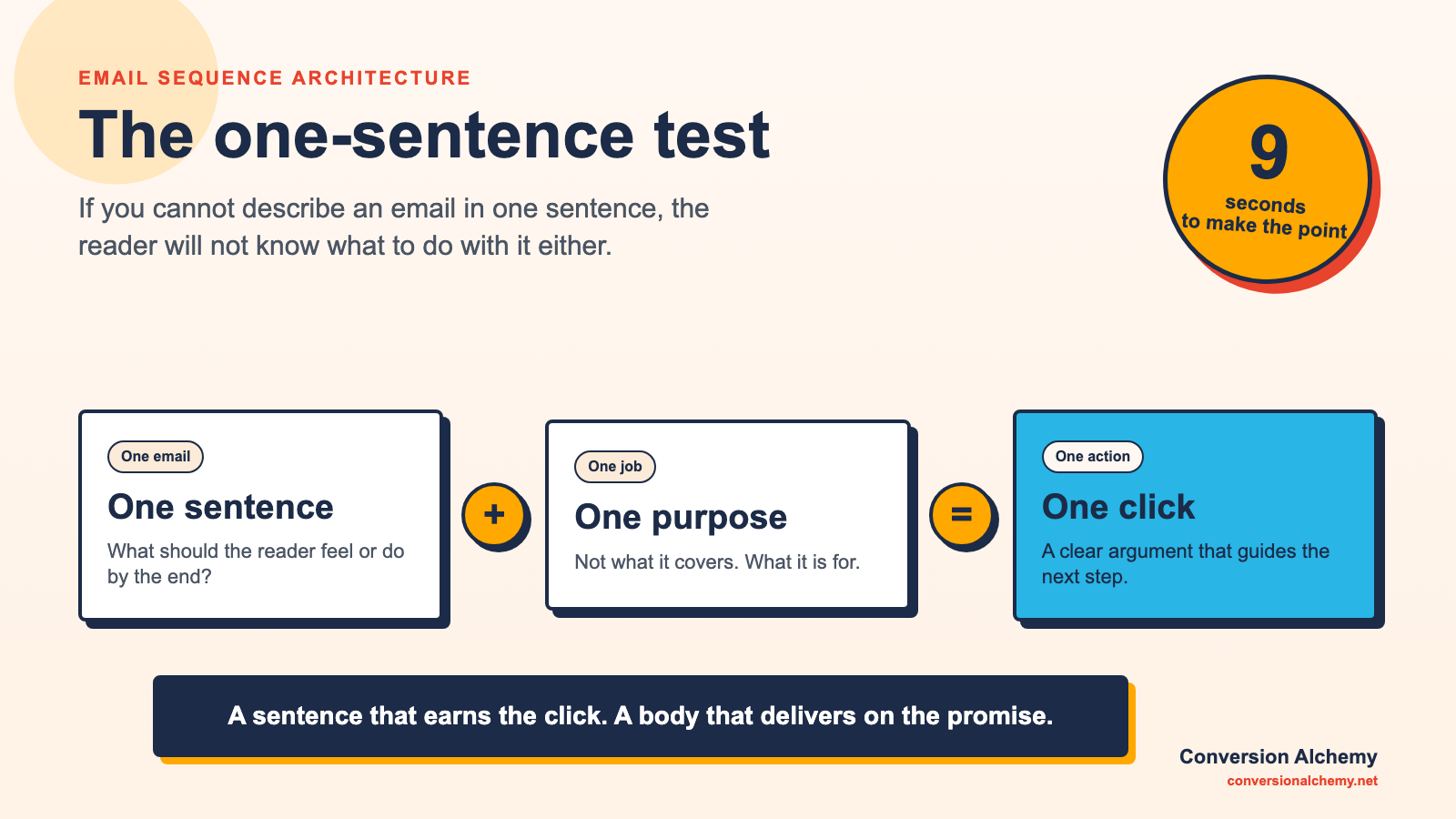
The stakes of getting this wrong have grown. Litmus’s Trends in Email Engagement report tracked the average time a reader spends with an email: 13.4 seconds in 2018, 11.8 in 2020, 10.0 in 2021, 8.97 in 2022. Your sequence is competing for attention that used to be measured in tens of seconds. Now it is measured in single digits. Nine seconds is not enough time to explain your product, it is barely enough time to make an argument. So if your emails are structured as explanations rather than arguments, you are losing before the click.
The main way this failure mode shows up is the feature tour.
Samuel Hulick, who literally wrote the book on user onboarding, has spent over a decade arguing against them: people do not want a tour of your product on day one. They want to do the thing they came to do.
Pendo’s 2024 Product Adoption Benchmark Report put a number on it: features highlighted in product tours were used by only 18% of new users within their first session. Twelve emails walking your prospect through your modules, one by one, is a feature tour in email form. It mirrors your product’s functionalities, not your prospect’s decision process.
And if you’re reading this you know we’re all about the psychology behind it.
The principle for email should be the same you follow for product: one email, one job. That is direct response orthodoxy, updated for the inbox by people like Joanna Wiebe at Copyhackers. How do you put this in practice? Replace your feature blabbering with a sequence of the outcomes your product delivers users.
Each email earns its place by closing the loop on one job the reader came to do, not by explaining one thing your product does.
The numbers from real product teams back this up. Userpilot’s case studies show companies rebuilding onboarding around user goals rather than feature lists and getting completion rates from the mid-teens into the 60s. The pattern holds across the funnel: emails three through five are where most sequences fall apart. That is where packing too many feature walkthroughs peaks — the assumption that the prospect is ready for your deep dive. They are not. They are still evaluating whether this is worth their time at all.
Look at the emails you get from Slack, Calendly, Notion — none of them send modules (most times). They send one completable outcome per email. You set up a channel, book a meeting, create a doc. The email simply closes the loop on something you actually wanted to do.
See it like this: a sentence that earns the click and a body that delivers on that promise + guides you to action.
Here is how to use the one-sentence test practically:
Take any email in your sequence and try to write one sentence that describes what the reader should feel or do by the end of it. Not what the email covers. What it is for.
Examples:
“This email is to show the reader that our reporting saves time on weekly reviews” — that is a description. “This email walks through our reporting dashboard” — that is a description of content, not purpose. If you cannot write the purpose sentence without hesitating or qualifying it, the email has more than one job. Split it and frame it as a narrative.
You want to draft your emails with this discipline in mind: every line should earn its place because it serves a single, articulable objective.
When you can describe each email in one sentence, your sequence becomes an actual argument. And an argument is what you need when you only have nine seconds.

DISCOVERY
After Automation — Dan Shipper
AI is creating more work for human experts, not less. AI is great inside a frame; humans set the frame. That is the moat. Read the “Zeno’s paradox of AI” section twice.
→ Read
The Frequency Era — Chris Walker
Currently reading this one. It’s a great model for thinking about where we came from and where we’re going between the agricultural, industrial, knowledge revolutions and the next one coming.
→ Read
How to Build an AI-Native Services Company — Y Combinator
This is something I’m starting to think about more and more. If you bill by the hour, AI just came for your whole industry. Here’s YC’s playbook for redesigning a services business so AI handles volume and humans handle judgment. Not an easy task, but the frame is opening my eyes a little.
→ Watch

RESONANCE
“Once you start to look at things this way, you’ll see compression everywhere. Emails are often compressions of what people said in meetings. Poems are compressions of sensory experiences. Good decisions are compressions of the results of previous decisions. Basic programming is compressions of Stack Overflow answers.”
Dan Shipper, What Can Language Models Actually Do?
Have a great weekend!
Cheers,
Chris

Chris Silvestri
Founder & conversion alchemist
🙌🏻 Let’s be friends (unless you’re a stalker)

When you’re ready, here’s a few ways I can help
🔍
Get a CXO audit
🙌
Let’s work 1-on-1
✍️
Turn words into gold
Not sure where to start? Take our free message-market fit scorecard.
Originally published at https://christophersilvestri.com/blog/can-you-describe-your-email-in-one-sentence/.