Welcome to Unpacking Meaning. If you received this from a friend and enjoy it, subscribe here.
A homepage can use real voice of customer and still be wrong.
I was reminded of this on a call this week.
A potential client had a homepage headline built from something a customer had said. Which is already better than most B2B homepages, to be fair.
No committee fluff.
No “unlock seamless growth.”
No category soup.
Actual customer language.
The line was something like:
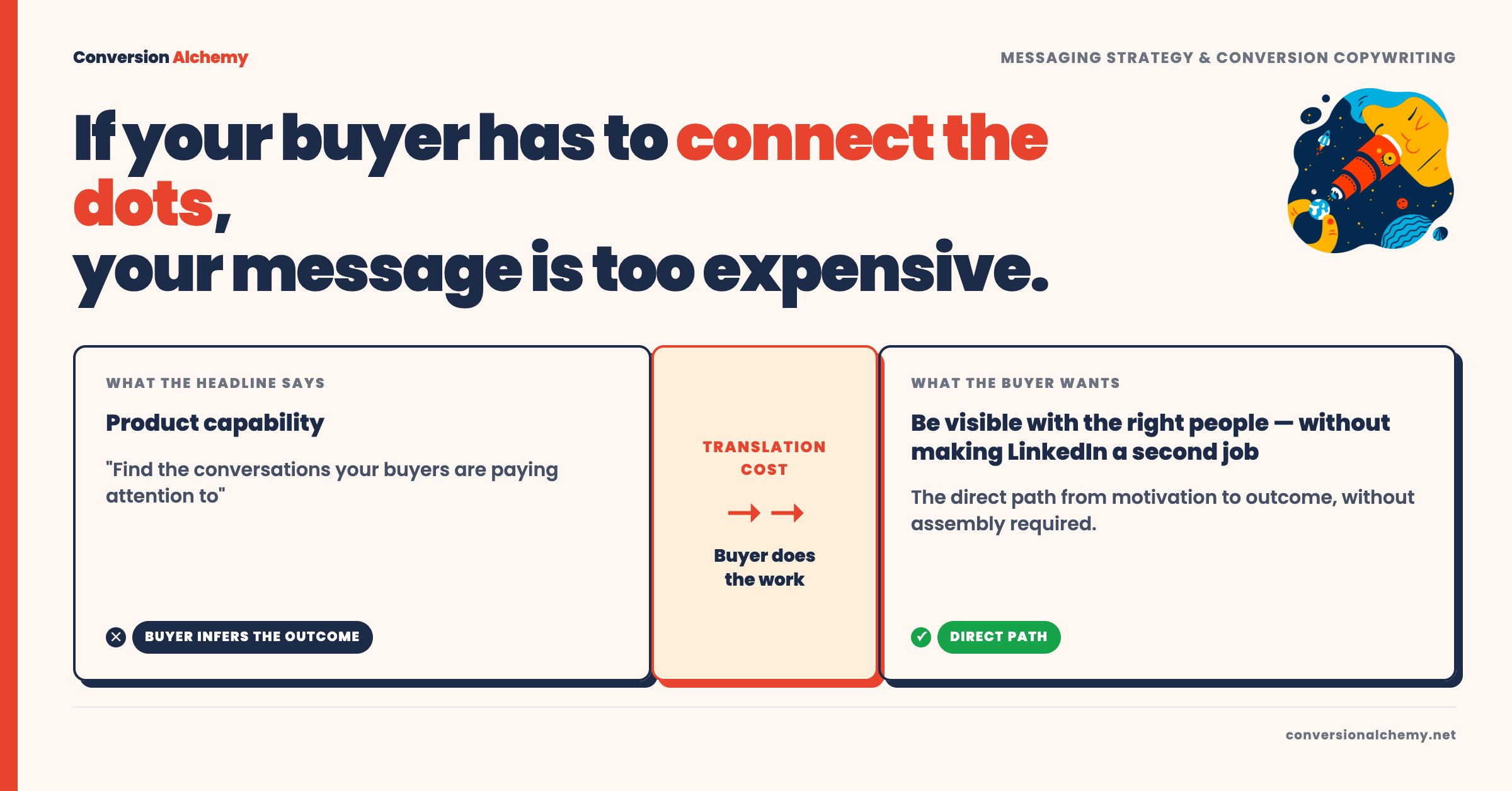
“Find the LinkedIn conversations your buyers are paying attention to.”
Useful? Yes.
But as a homepage headline, it was pointing at the wrong layer of value.
It described a product capability: finding relevant conversations.
What the buyer actually wants is closer to:
“Be more visible with the right people on LinkedIn without turning it into another full-time job.”
So when you landed on the page, you had to do the work yourself:
“If I can find the conversations my buyers are paying attention to… and I can engage with them… and I can do that consistently without wasting hours… then I can grow my reach with the right people on LinkedIn.”
That is a lot of translation for a first impression.
And this is the trap with voice of customer.
People hear “use your customer’s words” and think the job is to copy the sentence that sounds most authentic.
But customer language is raw material, not all of it belongs in the headline.
Some customer phrases describe the product. Some describe the workflow. Some describe the objection. Some describe the second-order benefit. Some describe the deeper motivation.
Your job is to decide which ones deserve their place in your copy. Your job is judgement.
Especially now, with AI sitting in the workflow, pulling transcripts, summarizing interviews, extracting themes, and handing you twenty plausible headlines before lunch.
The leverage is not in generating more options, but in knowing which layer of meaning the buyer needs first.
Because buyers do not arrive on your homepage as strategists.
They do not patiently assemble your value proposition from scattered clues.
They ask three questions, usually in this order:
- Is this for me?
- Does it solve the problem I actually care about?
- Do I trust this enough to keep going?
If your headline answers a technically accurate but emotionally premature question, the buyer has to bridge the gap.
And every bridge you make them build costs attention.
This is why “accurate” copy can still underperform.
It can be true and still too indirect. It can be customer-led and still point to the wrong motivation. It can sound clever and still force the buyer to translate.
Your goal is to make each next thought they read obvious. Like you’re reading their minds.
That is what good messaging does.It reduces the distance between what the buyer already wants and what you want them to understand next.The wider that distance, the more expensive your message becomes.
Not expensive in money.
Expensive in effort.
And on a homepage, effort is where attention goes to die.

DISCOVERY
Can AI describe what your product does?
Richard King makes a great point about AI-era positioning: your company is no longer described only by the sentence you approved on your homepage. AI tools synthesize your website, reviews, third-party mentions, comparison pages, and whatever else they can find.
The line that stuck with me: “You’re now positioned by consensus, not just by the copy you wrote.”
That connects directly to this week’s theme. If humans have to work too hard to understand you, machines probably will too. And if your message changes shape everywhere it appears, the compressed answer buyers get back will be vague at best.
Read it here: https://productmarketingalliance.substack.com/p/can-ai-describe-your-product
What Actually ARE Loops?
This is the clearest explanation I’ve seen of what people mean when they talk about “agent loops”: not a magic autonomous brain, but a repeatable cycle where an AI system drafts, checks, learns from the result, and tries again.
That matters for messaging work because so much of the job is iterative. You are not looking for one perfect output. You are looking for a better loop: draft a message, test the interpretation, spot where the meaning breaks, then tighten the next version.
Useful framing if you are thinking about AI-assisted messaging drafts, synthetic validation, or how to make the messy revision process more systematic.
Read it here: https://x.com/tonbistudio/status/2063861151524643291

RESONANCE
“We rarely hear information in exactly the same way the person sending us the information means it; instead, we attach our own emotion to the information and often change the message as a result.” — Jeff Booth, The Price of Tomorrow
That feels like the whole job of messaging in one sentence.
Have a great weekend!
Cheers,
Chris

Chris Silvestri
Founder & conversion alchemist
🙌🏻 Let’s be friends (unless you’re a stalker)

When you’re ready, here’s a few ways I can help
🔍
Get a CXO audit
🙌
Let’s work 1-on-1
✍️
Turn words into gold
Not sure where to start? Take our free message-market fit scorecard.
Originally published at https://christophersilvestri.com/blog/your-buyer-should-not-have-to-connect-the-dots/.